You may already know your short-term program helps learners move toward better work. Workforce Pell asks a harder question: Can your institution prove it with records that stand up to review?
For many teams, that is where the real work begins. Records of enrollment, completion, employment, pricing, and program structure may live in different systems, with different owners, and on different timelines. An application deadline is a poor time to find out that those pieces do not connect.
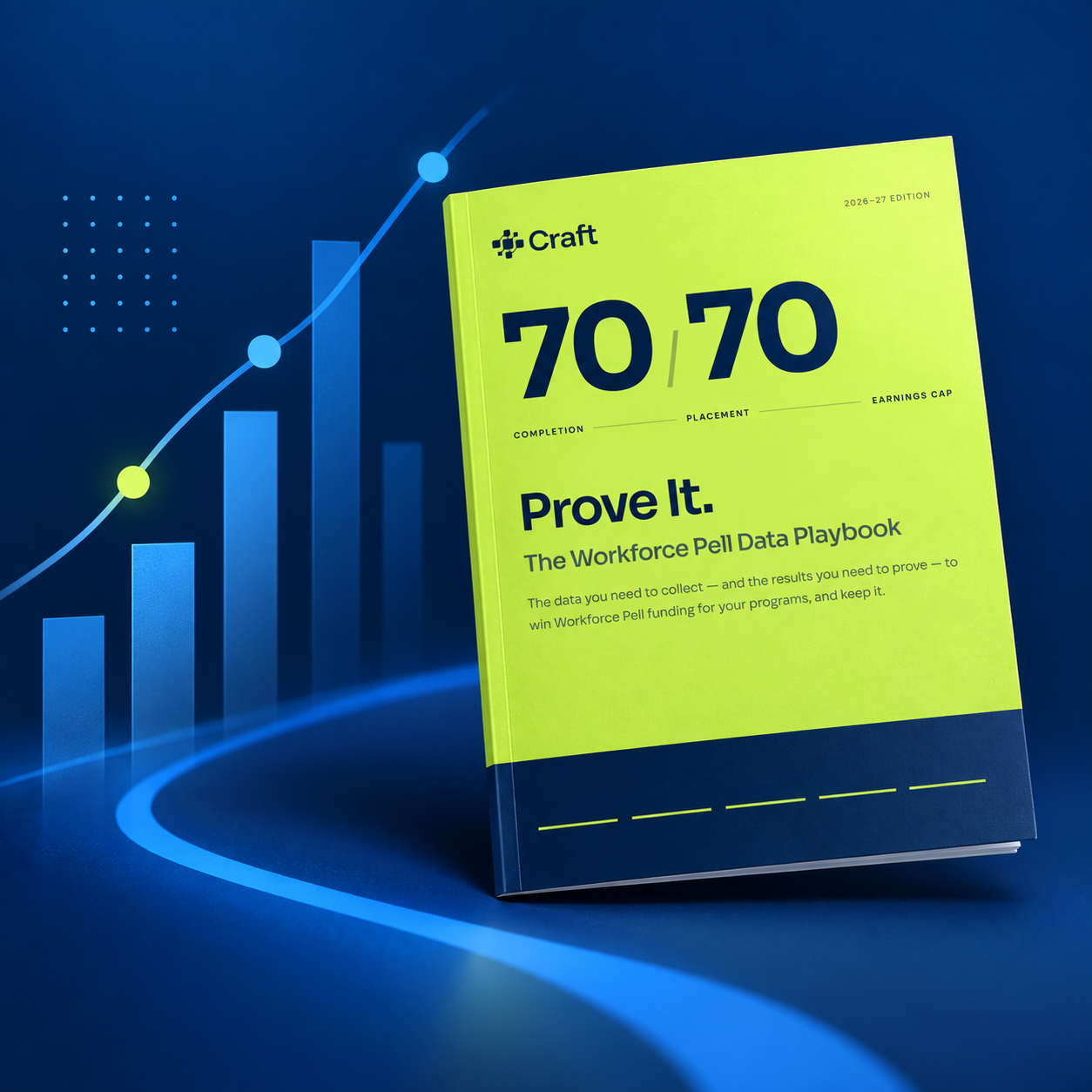
That is why we created the Workforce Pell Data Playbook. It helps teams turn scattered program signals into evidence they can use, explain, and maintain. This is not a reporting project for its own sake. It is the foundation for a program that is ready for review and prepared to keep up as requirements evolve.
Workforce Pell turns outcomes into an operating requirement
For years, many short-term and noncredit programs have been judged primarily by whether they meet a local workforce need, enroll learners, and deliver useful training. Those things still matter.
Workforce Pell adds another layer: institutions need to demonstrate how programs are performing for students after they enter and after they leave. In practice, that brings learner outcomes, program design, financial aid, institutional research, employer relationships, and state processes into the same conversation.
Eligibility is not a form to complete at the end of the process. It is an evidence trail that begins long before a submission is due.
For institutional leaders, we recommend starting with one question: What do we need to capture consistently so we are not reconstructing the story later?
Start with the full framework: Download the free Workforce Pell Data Playbook for the detailed data checklist, readiness scorecard, and planning guidance.
The data challenge is usually a coordination challenge
Most institutions do not start from zero. They already know who enrolled, who completed, which credential was earned, and which employers hire their graduates. The hard part is that this information may be held by different people, systems, and processes.
A continuing education team might maintain enrollment records. A financial aid office may own student eligibility workflows. Institutional research may work with reporting definitions and data quality. Career services, program staff, or employer partners may be closest to placement outcomes. Academic leaders may hold the documentation that connects a short-term credential to a broader academic pathway.
Each group has part of the answer. Workforce Pell readiness depends on whether those parts fit together.
That does not mean every team needs the same software. It does mean someone needs to establish common definitions, clear handoffs, responsible owners, and a dependable rhythm for checking what is missing. If a graduate’s outcome can only be confirmed through an annual spreadsheet chase, the process is fragile.
Start with the questions your records should answer
The most productive first step is not a massive data audit. It is a small group of leaders agreeing on the questions they need their records to answer at the program level.
For example, a Workforce Pell-ready view of a program should help a team understand:
- Program structure: How the credential fits in a learner’s broader pathway.
- Learner progress: Who entered, progressed, completed, withdrew, or transferred, with dates and consistent status definitions.
- Post-program outcomes: What happens to completers after exit, including employment outcomes that may require employer or state-data coordination.
- Price and value: How tuition, fees, and program value are documented over time.
The point is to see the difference between data that is interesting and data that is operational. An annual total of completions may be useful for program review. Workforce Pell readiness may require a more complete program-level record that can be explained and supported.
When teams work backward from those questions, they often discover gaps early: a status field that is inconsistent, an outcome that is not followed up, an employer relationship that is informal, or a credential pathway that is understood but not documented. Those are solvable issues when they surface during planning. They are much harder to solve at the point of submission.
Build a practice, not a one-time evidence scramble
The appeal of a one-time project is understandable. Pull the records, prepare the materials, submit the application, move on.
But outcome requirements make that approach risky. Programs need a repeatable way to document their performance and keep records current. The teams that will be best positioned are not necessarily the ones with the most elaborate reporting environment. They are the ones that make ownership explicit and build a routine that survives staff changes, new cohorts, and changing state implementation processes.
That routine might include a regular review of program records, a defined process for graduate follow-up, and a shared understanding of when employer partners or state data sources are needed. It should also include appropriate privacy, data-governance, financial aid, and legal review. Workforce Pell rules and implementation guidance can evolve, so institutions should confirm requirements with the relevant authorities and their own counsel before acting.
The goal is simple: when the institution needs to explain a program’s readiness, it should be able to do so from a process it already runs, not a file assembled under pressure.
The practical tools behind Workforce Pell data readiness
Getting from policy language to an operating plan is where many teams need a practical starting point. We created Prove It: The Workforce Pell Data Playbook for the people who need to make that work real: workforce and continuing education leaders, deans, financial aid directors, institutional research teams, and employer partners.
Rather than asking readers to decode the rules alone, the playbook provides a plain-English orientation to Workforce Pell and a structured way to think about readiness. It covers:
- the approval path at a high level;
- the outcome evidence institutions need to organize;
- timing considerations that can shape planning; and
- a master data checklist, readiness scorecard, and early planning guidance.
These are the working tools that do not belong in a short article, but they are exactly what helps a cross-functional team find gaps before a high-stakes submission.
Get the full Workforce Pell Data Playbook
If Workforce Pell is on your institution’s horizon, bring the people who own program delivery, student records, outcomes, finance, and partnerships into the same conversation early. Start with what your program data can answer today, then identify what needs a clearer owner or a more reliable process.
We designed the free playbook to give that conversation more than broad principles. It offers a clear starting point for assessing what your institution already has, what needs a stronger process, and who needs to be involved.
Ready to turn Workforce Pell from a policy question into an operating plan? Download Prove It: The Workforce Pell Data Playbook for free.
.webp)