
In the last five years, two key occupations have received federal approval as apprenticeable: K-12 teacher, approved in November 2021, and registered nurse, approved in July 2023. Together, these occupations account for about 7 million U.S. jobs, with nearly 4 million K-12 teachers and over 3 million registered nurses. Expanding the pathways into these professions is strategically important to renewing these two essential workforces.
The need for education and healthcare workers is substantial. A recent report published by Craft Education found that current teacher shortages amount to approximately 40,000 unfilled positions. The Health Resources and Services Administration projects a shortfall of over 200,000 Registered Nurses by the year 2028. These estimates underscore the importance of preparing more qualified professionals.
Federal recognition has helped create the conditions for apprenticeship expansion, alongside funding and partnerships between employers and education providers. Our analysis of Registered Apprenticeship Partners Information Database System (RAPIDS) records from reporting years 2020 to 2025 examines how that expansion has unfolded across education and healthcare occupations, including its reach outside metropolitan areas. Our findings show substantial growth from a small base, with important differences in its pace and geographic reach.
Small-scale and rapid growth coexist
Skilled trades still dominate the apprenticeship landscape, and new apprenticeships in nursing and education occupations accounted for only 2% to 3% of all new apprentices in 2025. Yet the growth in new apprentices in these occupations tells a different story (see Figure 1). From 2020 to 2025, the number of new apprentices in education and instructional occupations increased more than fortyfold, from roughly 150 to 6,587. The scale remains modest relative to the workforce these programs could help replenish, but the pace of expansion shows that apprenticeship is becoming a more widely used preparation model in education.
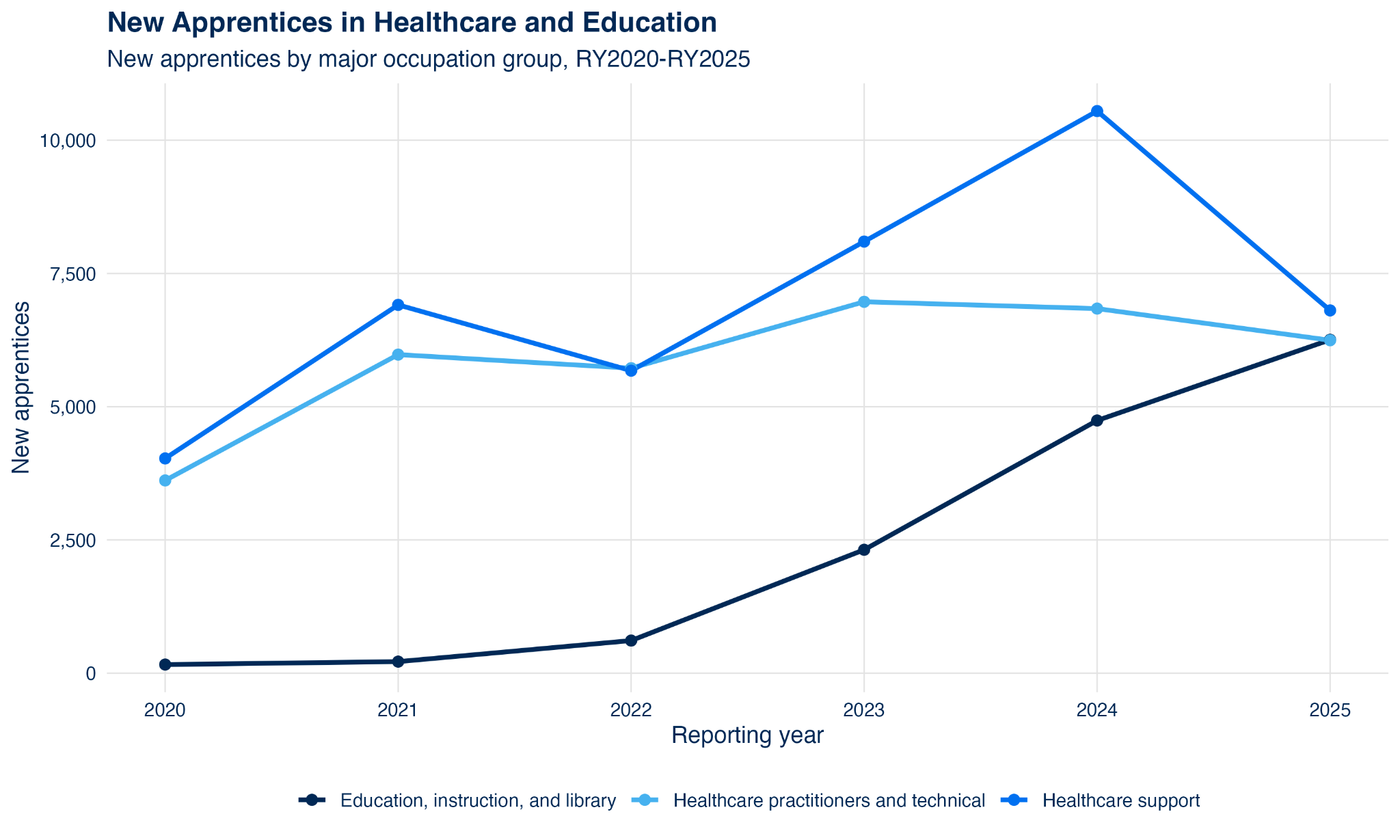
Growth has been less consistent in healthcare. Both healthcare practitioners and healthcare support occupations saw growth in new apprentices during the study period, but with declines in the most recent year. This uneven pattern raises a question: what helps apprenticeship pathways continue to expand where workforce need remains substantial?
For occupations such as teaching and nursing, preparation involves extensive classroom training and must meet numerous regulations and credentialing requirements. Establishing apprenticeship programs, therefore, requires substantial coordination and institutional capacity. For policymakers and employers, this presents an opportunity to examine the conditions that help programs sustain participation. Continued growth, along with successful completion and entry into the workforce, will determine how much these programs can contribute to education and healthcare staffing needs.
Expansion outside of metropolitan areas
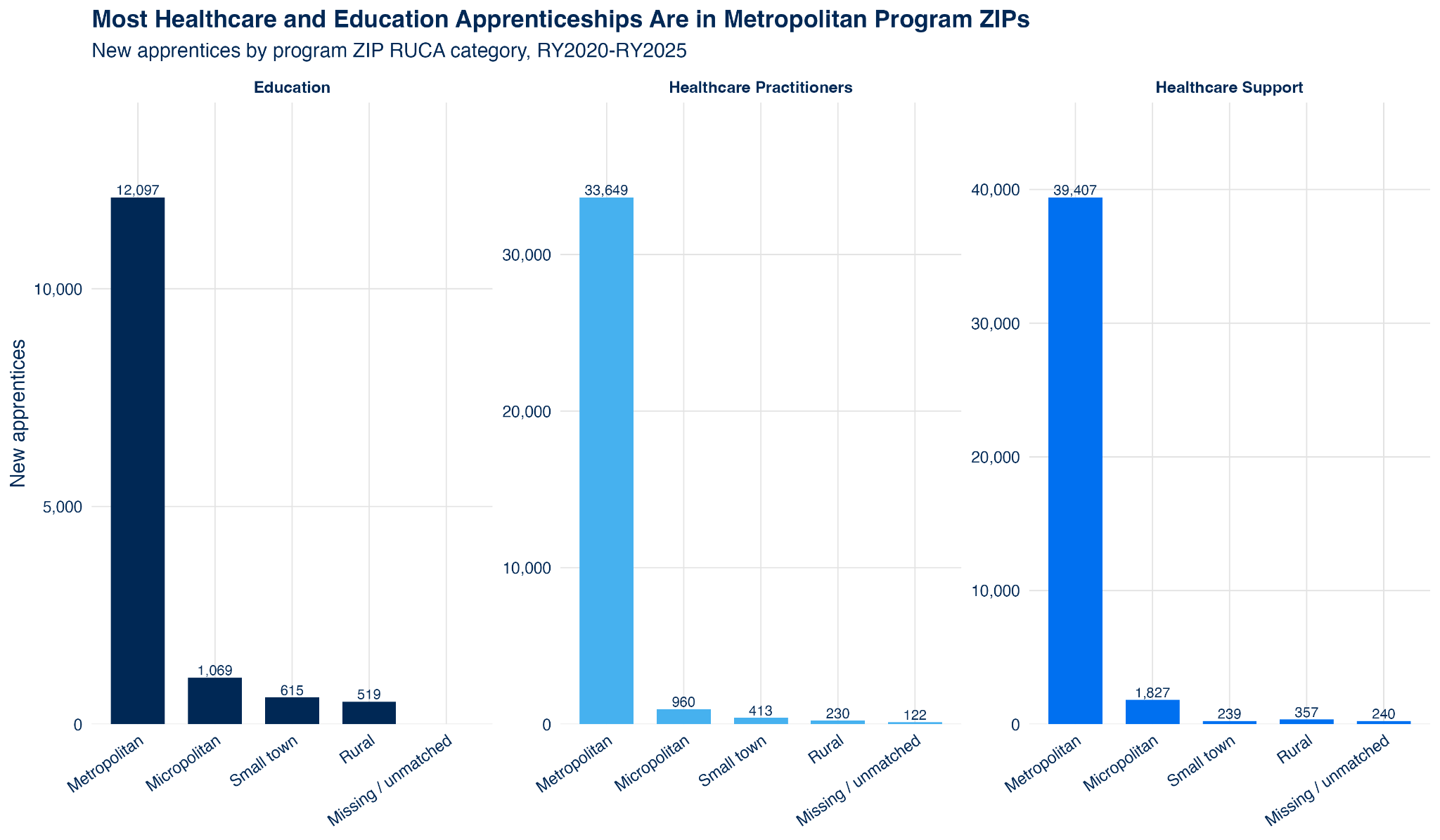
While most new apprentices in our analysis are associated with programs in metropolitan areas, as seen in Figure 2, this concentration does not mean apprenticeship expansion is confined to those areas. Looking separately at smaller communities reveals growth that could be missed without an intentional focus on these geographies.
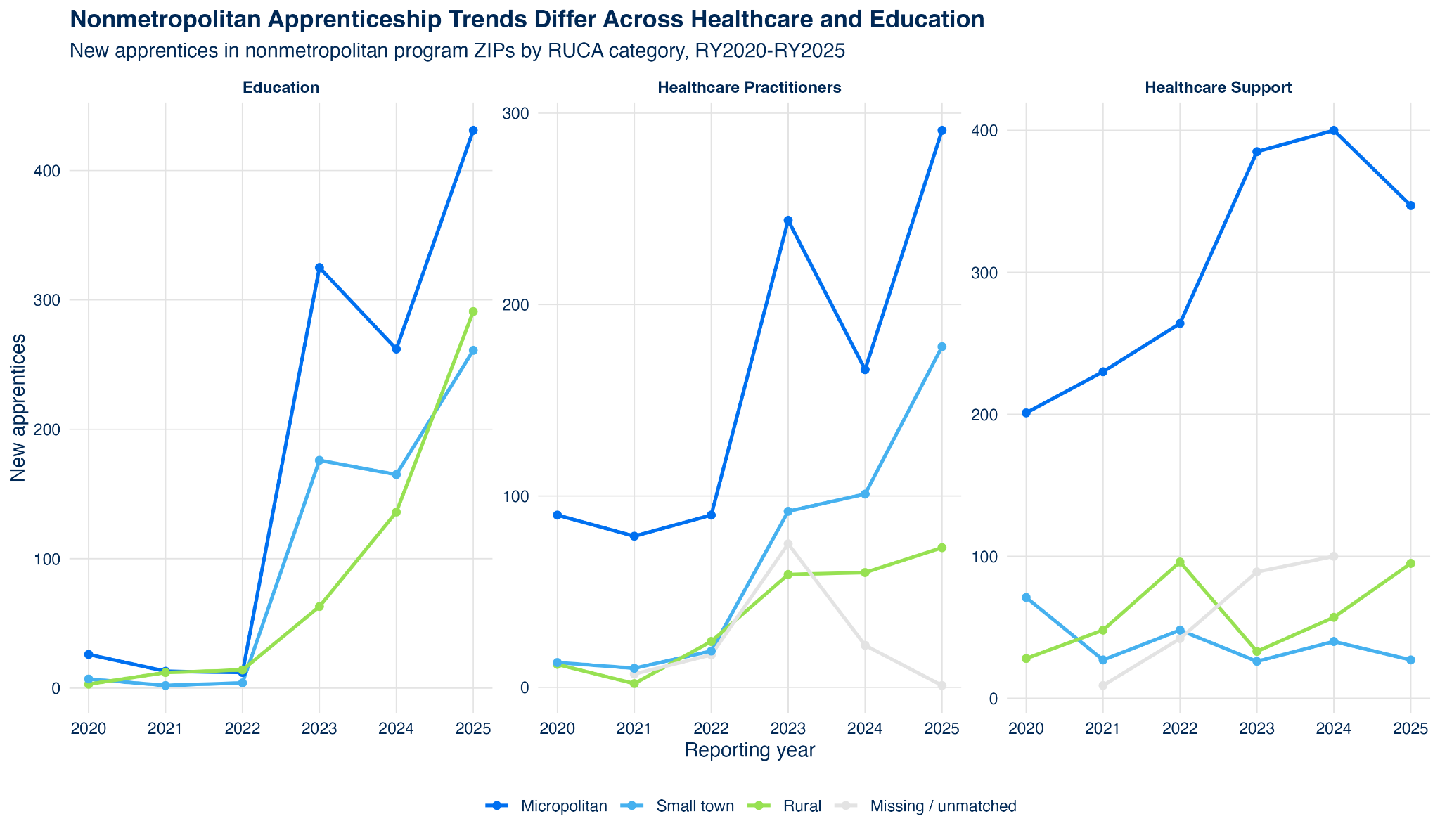
As shown in Figure 3, new education apprentices associated with rural and small-town programs increased sharply in the last few years. New healthcare apprentices have also expanded in several nonmetropolitan settings, although less consistently and with more fluctuations. These findings support examining local pathways separately, as they may face different barriers to expansion.
This geographic detail is particularly relevant to both nursing and teaching. HRSA projects a 24% shortfall in nonmetropolitan areas for 2028, compared to 5% in metropolitan areas. NCES found that rural public schools had greater difficulty filling vacancies than schools in cities or suburbs. Supporting nonmetropolitan apprenticeship pathways can help prepare workers in places where persistent shortages are particularly acute.
Program location, however, is only a first step towards understanding who has access to pathways and which communities benefit. A program’s location does not establish where its apprentices train or where its graduates will work. Understanding its contribution to local staffing requires connecting apprenticeship records with education, licensure, and employment data that allows us to evaluate what happens after apprentices complete their programs. That evidence can also help employers and policymakers decide where and how to support further expansion.
Sustaining apprenticeship expansion
Sustained expansion, therefore, requires attention to both the conditions that make programs accessible and the outcomes they produce. There is a clear opportunity to expand the education and healthcare workforces through apprenticeships, but there is more to it than merely increasing the number of available training sites. New America’s research on teacher apprenticeships, for example, identifies affordability, sustainable partnerships, and instructional quality as central design priorities for apprenticeship pathways.
Our RAPIDS analysis shows substantial, albeit uneven, expansion of education and healthcare apprenticeships, raising questions about what helps programs in different settings and industries sustain participation. Connecting apprenticeship records with completion, licensure, and employment data would help us understand whether that participation translates into qualified professionals, stable employment, and family-sustaining wages.
The growth to date gives us a reason to invest in these pathways. Understanding where participants succeed and where they encounter barriers will help better direct that investment towards pathways designed to meet local workforce needs.
Citations
[1] DOL Office of Apprenticeship Bulletin2022-18.
[2] DOL Office of Apprenticeship Bulletin2023-111.
[3] BLS national employment table.
[4] HRSA health workforce projections.
[5] Copson et. al. (2022). Abt Associates.Implementing Registered Apprenticeship Programs: Experiences of 10 AmericanApprenticeship Initiative Grantees. Chief Evaluation Office, U.S. Department ofLabor.
Love, I., & Goetz, B. (2026). Degree apprenticeship: A remedy forthe health care talent crisis. New America.
American Association of Colleges of Nursing (2025). Schools of NursingEnrollment Increases Across Most Program Levels, Signaling Strong Interest inNursing Careers. June 17, 2025 survey release.
[6] HRSA health workforce projections.
[7] New America (2026). Living Up to Its Promise:Three Ways to Make Teacher Degree Apprenticeship Programs Work.